
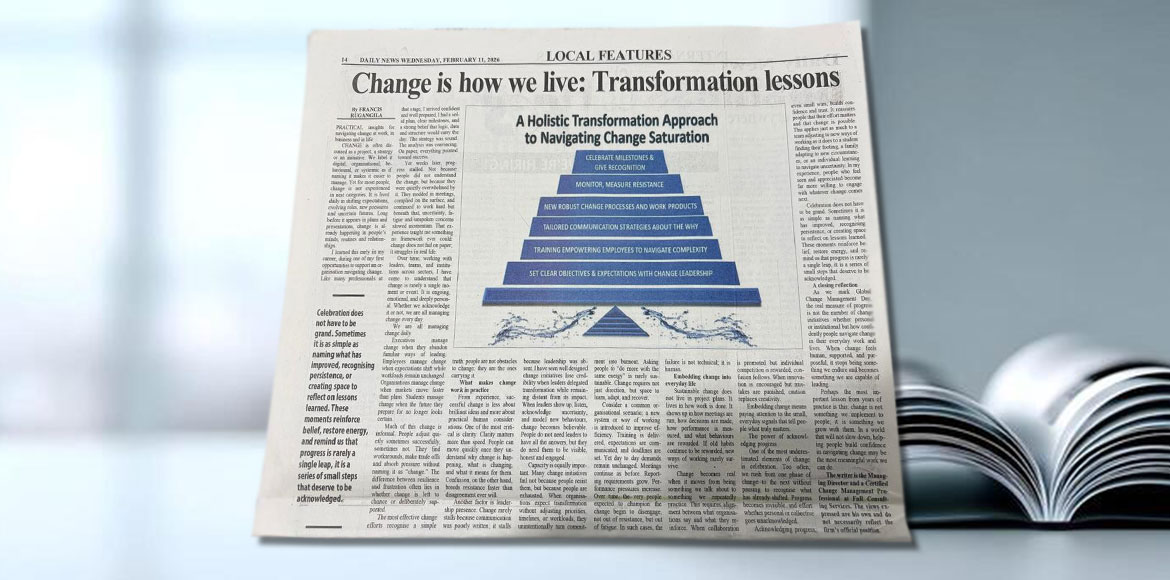
Practical insights for navigating change at work, in business, and in life
Change is often discussed as a project, a strategy, or an initiative. We label it digital, organisational, behavioral, or systemic, as if naming it makes it easier to manage. Yet for most people, change is not experienced in neat categories. It is lived daily in shifting expectations, evolving roles, new pressures, and uncertain futures. Long before it appears in plans and presentations, change is already happening in people’s minds, routines, and relationships.
I learned this early in my career, during one of my first opportunities to support an organisation navigating change. Like many professionals at that stage, I arrived confident and well prepared. I had a solid plan, clear milestones, and a strong belief that logic, data, and structure would carry the day. The strategy was sound. The analysis was convincing. On paper, everything pointed toward success
Yet weeks later, progress stalled. Not because people did not understand the change, but because they were quietly overwhelmed by it. They nodded in meetings, complied on the surface, and continued to work hard but beneath that, uncertainty, fatigue, and unspoken concerns slowed momentum. That experience taught me something no framework ever could: change does not fail on paper; it struggles in real life.
Over time, working with leaders, teams, and institutions across sectors, I have come to understand that change is rarely a single moment or event. It is ongoing, emotional, and deeply personal. Whether we acknowledge it or not, we are all managing change every day.
We Are All Managing Change Daily
Executives manage change when they abandon familiar ways of leading. Employees manage change when expectations shift while workloads remain unchanged.Organisations manage change when markets move faster than plans. Students manage change when the future they prepare for no longer looks certain.
Much of this change is informal. People adjust quietly sometimes successfully, sometimes not. They find workarounds, make trade offs, and absorb pressure without naming it as “change.” The difference between resilience and frustration often lies in whether change is left to chance or deliberately supported.
The most effective change efforts recognize a simple truth: people are not obstacles to change; they are the ones carrying it.
What Makes Change Work in Practice
From experience, successful change is less about brilliant ideas and more about practical human considerations. One of the most critical is clarity. Clarity matters more than speed. People can move quickly once they understand why change is happening, what is changing, and what it means for them. Confusion, on the other hand, breeds resistance faster than disagreement ever will.
Another factor is leadership presence. Change rarely stalls because communication was poorly written; it stalls because leadership was absent. I have seen well designed change initiatives loose credibility when leaders delegated transformation while remaining distant from its impact. When leaders show up, listen, acknowledge uncertainty, and model new behaviors, change becomes believable. People do not need leaders to have all the answers, but they do need them to be visible, honest, and engaged.
Capacity is equally important. Many change initiatives fail not because people resist them, but because people are exhausted. When organisations expect transformation without adjusting priorities, timelines, or workloads, they unintentionally turn commitment into burnout. Asking people to “do more with the same energy” is rarely sustainable. Change requires not just direction, but space to learn, adapt, and recover.
Consider a common organisational scenario: a new system or way of working is introduced to improve efficiency. Training is delivered, expectations are communicated, and deadlines are set. Yet day to day demands remain unchanged. Meetings continue as before. Reporting requirements grow. Performance pressures increase. Over time, the very people expected to champion the change begin to disengage, not out of resistance, but out of fatigue. In such cases, the failure is not technical; it is human.
Embedding Change into Everyday Life
Sustainable change does not live in project plans. It lives in how work is done. It shows up in how meetings are run, how decisions are made, how performance is measured, and what behaviors are rewarded. If old habits continue to be rewarded, new ways of working rarely survive.
Change becomes real when it moves from being something we talk about to something we repeatedly practice. This requires alignment between what organisations say and what they reinforce. When collaboration is promoted but individual competition is rewarded, confusion follows. When innovation is encouraged but mistakes are punished, caution replaces creativity.
Embedding change means paying attention to the small, everyday signals that tell people what truly matters.
The Power of Acknowledging Progress
One of the most underestimated elements of change is celebration. Too often, we rush from one phase of change to the next without pausing to recognize what has already shifted. Progress becomes invisible, and effort whether personal or collective goes unacknowledged.
Acknowledging progress, even small wins, builds confidence and trust. It reassures people that their effort matters and that change is possible. This applies just as much to a team adjusting to new ways of working as it does to a student finding their footing, a family adapting to new circumstances, or an individual learning to navigate uncertainty. In my experience, people who feel seen and appreciated become far more willing to engage with whatever change comes next.
Celebration does not have to be grand. Sometimes it is as simple as naming what has improved, recognising persistence, or creating space to reflect on lessons learned. These moments reinforce belief, restore energy, and remind us that progress is rarely a single leap it is a series of small steps that deserve to be acknowledged.
A Closing Reflection
As we mark Global Change Management Day, the real measure of progress is not the number of change initiatives whether personal or institutional but how confidently people navigate change in their everyday work and lives. When change feels human, supported, and purposeful, it stops being something we endure and becomes something we are capable of leading.
Perhaps the most important lesson from years of practice is this: change is not something we implement to people; it is something we grow with them. In a world that will not slow down, helping people build confidence in navigating change may be the most meaningful work we can do.
Francis Rugangila is the Managing Director and a Certified Change Management Professional at FnR Consulting Services. The views expressed are his personal perspectives and do not necessarily reflect the official position of the firm.